Every founder we sit down with is excited about the visible parts of the work: the name, the packaging, the flower or the hardware, the story, the launch.
Almost none of them arrive thinking about the stage where a product fails feasibility, where a package cannot carry the required information, where a claim creates a compliance problem, or where a retailer likes the product but cannot explain it to customers.
That is not a criticism. Those stages are difficult to see from the outside. Most become obvious only after someone has already reached them, paid for them, revised them, or watched them cause trouble downstream.
After years of building in this industry, we mapped the work into the 1OFF Brand-to-Market System: eight possible entry points followed by 36 stages spanning brand strategy, product development, packaging, compliance, production, go-to-market, and post-launch learning.
The map is not a binding process, and it is not a claim that every client needs every service. It is a working model of the decisions that eventually have to be made somewhere, by someone, before a product can become a durable brand in the market.
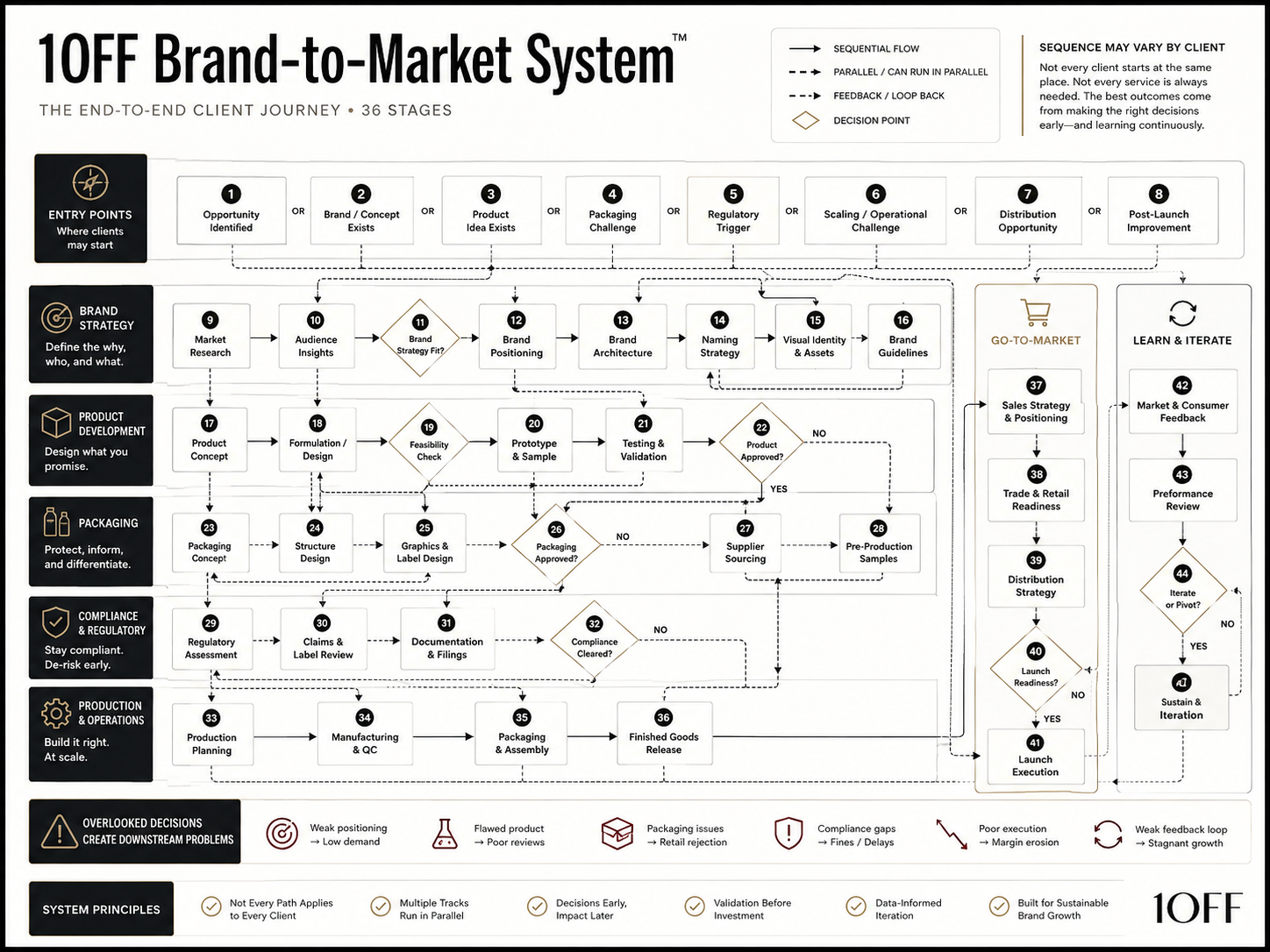
How to read the map
The boxes matter, but the arrows matter just as much.
A solid arrow shows work that normally advances in sequence. A dashed path shows work that can run in parallel. A loop-back shows that a later discovery can force an earlier decision to be reconsidered. A diamond marks a decision gate: strategy fit, feasibility, product approval, packaging approval, compliance clearance, launch readiness, or the choice to iterate or pivot.
That distinction is important. A checklist can tell you what needs to exist. A system map shows how one decision affects the next one, which work can safely happen together, and where an apparently small shortcut can become an expensive correction.
You do not start at stage one
The map opens with eight possible entry points because clients rarely arrive in the same condition.
A founder may have identified an opportunity but have no product. Another may already have a product and need a brand. An established brand may need packaging, compliance, distribution, or a way to scale. A post-launch brand may come in because sell-through is weak, the product is confusing retailers, or the first version exposed an operational problem.
The starting point changes. The work that remains does not disappear.
A client who already has a logo may still need positioning. A client who already has a product may still need feasibility testing. A client with distribution may still need trade readiness. A founder who has assembled most of the pieces may still be missing the connections between them.
That is why the first useful question is not, “Which service do you want?”
It is:
What already exists, what is still an assumption, and what must become true before the next investment makes sense?
Five core lanes, moving together
The center of the system contains five functional lanes. They are shown separately so the responsibilities are legible, but in practice they constantly influence one another.
Brand Strategy
The brand lane begins with market research and audience insight, then moves through a real strategy-fit decision before positioning, architecture, naming, visual identity, and guidelines.
The strategy-fit gate is deliberately early. If the audience, promise, competitive position, price, and product story do not fit together, polishing the identity only makes the wrong idea look more finished.
This is one of the first places experience prevents waste. A founder may ask for a new logo when the actual problem is that the product is not clearly positioned. The visible request is design; the underlying need is strategic definition.
Product Development
The product lane moves from concept through formulation or design, feasibility, prototypes, testing, and approval.
The product may be flower, concentrate, edible, hardware, packaging-dependent delivery, or another format. The details vary, but the principle does not: the product must be technically possible, repeatable, safe, scalable, and capable of delivering the promise the brand makes.
If testing fails, the work loops back. That is not a failure of the process. It is the process doing its job before the market performs the test at a much higher cost.
Packaging
Packaging begins as a concept, becomes a structure, receives graphics and label design, passes an approval gate, and then moves into sourcing and pre-production sampling.
This lane is where brand ambition, product reality, compliance, cost, and supply-chain conditions collide.
A package can look excellent on screen and still fail because the label area is too small, the material reacts poorly with the product, the minimum order is excessive, the finish is inconsistent, the container breaks in transit, or the supplier cannot reproduce it six months later.
The package is not only a visual surface. It is also a legal object, a manufacturing component, a shipping unit, a retail tool, and part of the customer experience.
Compliance and Regulatory
Compliance runs beside the other lanes rather than appearing at the end.
Regulatory assessment, claims review, label review, documentation, filings, and clearance can affect naming, product formulation, package structure, typography, copy, promotions, events, and retail presentation.
When compliance is treated as a final inspection, it has the power to reject work that has already been designed, sourced, printed, or produced. When it enters early, it becomes a design constraint that prevents avoidable rework.
The difference is simple:
Compliance is less expensive as an input than as a rejection.
Production and Operations
Production converts all the upstream decisions into a repeatable physical system.
Planning leads into manufacturing and quality control, then packaging and assembly, then finished-goods release.
This is where specifications, vendors, tolerances, schedules, inventory, packaging components, quality standards, and approvals have to converge. It is also where a vague decision made months earlier becomes a concrete expense.
A design is not finished because it has been approved in a presentation. It is finished when it can be produced reliably, inspected consistently, assembled correctly, reordered, and released without inventing the process again.
The gates are where experience saves money
The system contains several approval and decision points because progress is not the same as readiness.
A strategy can be attractive without fitting the opportunity. A product can be promising without being feasible. A package can look complete without being producible. A label can be legible without being compliant. Finished goods can exist without the market being ready for them.
Each gate asks whether the next investment is justified.
This is often where an experienced partner brings up the detail the founder did not know to consider:
- Can the name be protected?
- Can the container be sourced at the expected volume?
- Can the product survive the shipping conditions?
- Can the label carry all required information at its actual size?
- Can the initial SKU count be supported by the available capital?
- Can production replenish inventory if the first accounts reorder quickly?
- Can a buyer understand the product, margin, audience, and reason to stock it?
- Can retail staff explain it in one sentence?
The value is not only in knowing how to complete each stage. It is in recognizing which early decision is likely to become a later problem.
Go-to-market is another system, not a final handoff
Finished goods do not automatically create a successful launch.
The go-to-market lane still includes sales strategy and positioning, trade and retail readiness, distribution strategy, a launch-readiness decision, and launch execution.
That means translating the product into forms different audiences can use:
- The consumer needs to understand what the product is and why it matters.
- The buyer needs to understand margin, placement, demand, and account fit.
- The retail staff needs a clear explanation and enough confidence to recommend it.
- The distributor needs inventory, documentation, routing, and reorder logic.
- The brand team needs content, support materials, launch timing, and a way to monitor what happens.
Distribution can move a product into stores. It cannot make an unprepared product move out of them.
Getting onto the shelf is an event. Staying on the shelf is a system.
Launch begins the learning loop
The final lane makes the map circular.
After launch come market and consumer feedback, performance review, and a decision to sustain, iterate, or pivot. That feedback can send work back into positioning, product, packaging, retail education, territory planning, inventory allocation, or another part of the system.
A launch turns assumptions into evidence.
The market may reveal that customers misunderstand the product, that one package variant is easier to sell, that a different audience responds more strongly, that some stores reorder faster than others, or that a message that worked in the presentation does not work at the counter.
A functioning feedback loop converts those observations into decisions. A weak one allows the same problems to repeat while the brand spends more money promoting them.
Where the system usually breaks
The recurring failures are not random. They are downstream symptoms of upstream decisions:
- Weak positioning becomes low demand.
- A flawed product becomes poor reviews.
- Packaging problems become retailer rejection.
- Compliance gaps become fines, delays, or forced revisions.
- Poor execution becomes margin erosion.
- A weak feedback loop becomes stagnant growth.
The risk becomes greater when the work is divided among separate vendors who see only their own assignment.
The brand studio may not know what the co-packer has changed. The packaging supplier may not know what compliance requires. The distributor may not know what the sales materials promise. The web team may be working from old product information. Each specialist can perform competently while the total system remains disconnected.
Someone still has to own the dependencies, the approvals, the current version, and the loop-backs.
Without 1OFF, this is your roadmap
A founder can build this system internally. They can hire a strategist, product specialist, designer, packaging supplier, compliance advisor, manufacturer, content team, sales representatives, distributor, event staff, and technical vendors separately.
That can work.
But the coordination does not disappear. It transfers to the founder.
Without an integrated partner, this map becomes the founder’s roadmap and task list:
- Define the complete scope.
- Decide what happens first.
- Identify what can run in parallel.
- Assign every responsibility.
- Find qualified specialists.
- Keep every specialist working from the same assumptions.
- Resolve conflicts between creative, compliance, production, sales, and distribution.
- Confirm that approvals happen before the next investment.
- Maintain the current files, specifications, claims, and decisions.
- Recognize when a later discovery invalidates earlier work.
- Decide when the project is ready to move forward.
- Monitor the market and begin the next iteration.
Building the brand yourself does not eliminate the work of an integrated partner. It means performing or coordinating that work yourself.
Why sequence matters more than the checklist
The purpose of the map is not to imply that every project must follow a rigid order.
Not every path applies to every client. Multiple tracks can run at the same time. Some clients enter halfway through. Some need brand development but not distribution. Others need packaging, compliance, manufacturing, or retail support without a full rebrand.
What matters is that the sequence remains intentional.
The strongest projects tend to share a few principles:
- Make defining decisions early.
- Bring compliance into the work before creative and production are locked.
- Validate before increasing investment.
- Allow product, packaging, brand, and operations to inform one another.
- Treat launch as the beginning of learning, not the end of the engagement.
- Preserve clear ownership of the complete system.
That is the difference between building a brand and assembling one.
Why 1OFF built the system
We built 1OFF because we do not think the founder should have to hold every dependency alone.
With 18 years in the industry, an internal creative and manufacturing team, New York City and Buffalo distribution hubs, and current reach across 341 stores in the greater New York area, we can connect brand strategy, product development, packaging, compliance, manufacturing, sales, and distribution inside one accountable system.
The 36 stages do not disappear when a client brings in a partner.
What changes is the number of places where context can be lost, responsibilities can become ambiguous, and a small oversight can quietly travel into the next stage.
Ready to locate your brand on the map?
Some clients arrive with an opportunity. Some already have a product, identity, package, or route to market. The useful starting point is identifying what is complete, what is missing, and which assumptions should be tested before the next investment.